
Q2 in Review
As we move into the second half of the year, the investment landscape remains positive, even as the broader economic situation continues to send mixed signals. Market returns have been strong, especially in segments that had lagged for some time. At the same time, inflation concerns, higher energy prices, trade uncertainty, and geopolitical tensions, especially with Iran, have continued to weigh on consumer sentiment.
This mixed environment can be confusing. It is useful to remember that markets and emotions do not always move in sync. Strong returns do not eliminate risk, and uncertainty does not necessarily derail long-term progress. In our view, the current environment reinforces the value of staying disciplined, diversified, and focused on matching your investment strategy to your long-term financial plan. In the following commentary, we highlight recent market performance, review current consumer and corporate trends, and share a few observations on fundamental developments in health and energy that you may find uplifting.
First, how is the market?
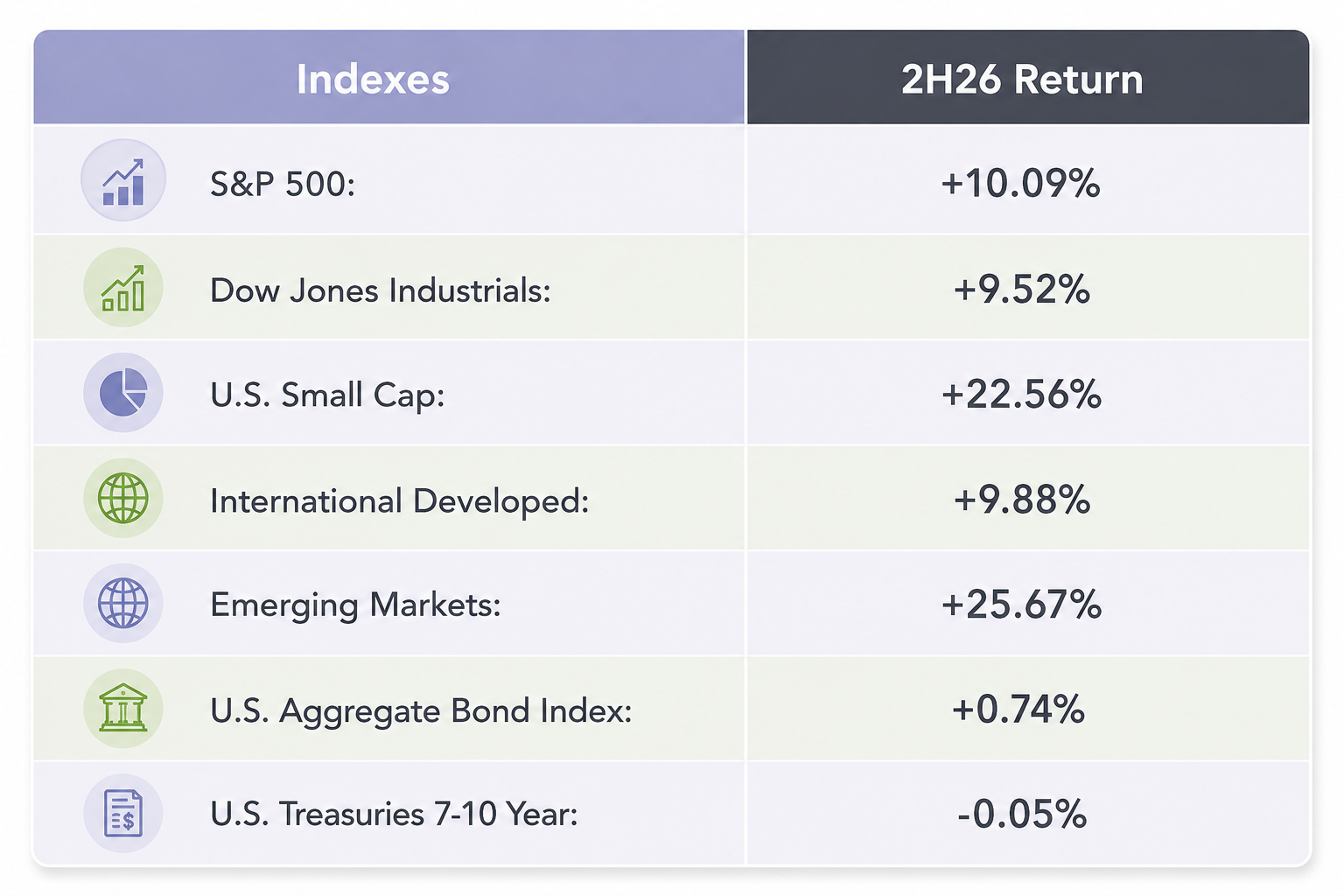
Over the past six months, financial markets delivered strong returns across most stock categories, with some of the best results coming from areas outside the large U.S. company segment. Emerging markets led with a gain of 25.67%, and U.S. small-cap stocks rose 22.56%, more than twice the 10.09% increase in the S&P 500, while international developed stocks returned 9.88%. Bond returns were much more muted, with the 7-10 year U.S. Treasury index essentially flat at -0.05%.
These results remind us that previously lagging asset classes can rebound sharply, and periods of strong returns do not remove the importance of staying diversified and focused on long-term goals. Bonds continued to play a stabilizing role, even though returns remained limited in a still-uncertain interest rate environment. Overall, the past six months were positive for diversified investors, but maintaining perspective and discipline remains just as important after strong markets as it is during more challenging ones.
 Are consumers OK?
Gas prices and inflation were the big story
During the second quarter, gas prices rose to more than $4/gallon, mainly due to the conflict with Iran. And, along with that, inflation as measured by the Personal Consumption Expenditures (PCE) Index rose to 4.1%, its highest level in about three years. It may take a while, but theoretically, as the conflict with Iran subsides, energy prices will return to their prewar level, and inflation should come back down.
Consumers are concerned
In large part due to energy prices and the accompanying inflation, consumer sentiment hit its lowest level in the history of the University of Michigan’s Consumer Sentiment survey in May. Basically, people’s expectations for the economy were less hopeful just a month ago than during the Vietnam War, the stagflation era of the 1970s, the period following 9/11 and the Internet bubble crash, the Great Financial Crisis, and the global economic shutdown of 2020. Sentiment has recovered a bit from the May low, but it remains historically low. It’s remarkable how pessimistic consumers are, especially when contrasting with the strong fundamentals in the economy and the financial markets.
Investors have a lot of cash
Investors hold 8% of their assets in cash now, more than in the past 30 years.
While asset prices have continued to climb quite dramatically, it’s notable that cash on hand hit a record high and that the percentage of total financial assets has grown to more than 8%. This is the highest percentage of cash held in more than thirty years. This would suggest that, at least in the aggregate, households may be better positioned to endure a potential market downturn than they have been in quite some time.
The corporate perspective
Trade policy is still uncertain
Companies seem to have adjusted to the endemic trade policy uncertainty that has plagued us for the past couple of years. Between the tariff situation, the renegotiation of the USMCA, and the Strait of Hormuz crisis, the world has been rolling from one trade crisis to another. Companies have had to stop waiting for a stable environment and instead adjust to making import, export, and manufacturing decisions based on the rules in effect at specific moments in time.
The most recent hit to trade policy uncertainty is the Trump administration’s decision not to renew the USMCA trade agreement, the current iteration of NAFTA.
The downside of this situation is that it is difficult to plan for the long-term, and that will affect companies from a cost and production perspective, and the economy with more inflationary pressure.
Corporate Profits are healthy
Despite the economic uncertainty we have endured through the first half of the year, corporate America’s ability to generate profits continues to impress. After-tax corporate profits now represent 12.4% of U.S. gross domestic product, the second-highest quarterly reading ever, dating back to 1947. Furthermore, Wall Street expects earnings to continue growing, at least for the foreseeable future. Clearly, this is a major driver of the continued health of the economy and the financial markets.
Companies are buying a lot of equipment
Companies are increasing their equipment investments. This is driven largely by the ongoing AI revolution. The so-called “hyperscalers” are building massive computing capacity to address the continuing AI usage rise. The Big 4 (Amazon, Google, Microsoft, and Meta) are expected to invest $630 billion in their infrastructure in 2026. Currently, these investments are driving a lot of the economy. Eventually, as with the massive investment in network infrastructure in the late 90s, the benefit is expected to spread to the rest of the economy.
What about Investing?
Diversification works
From the Great Financial Crisis through 2024, the investing landscape was dominated by large-cap U.S. stocks, especially tech.
Last year, continuing into this year, other areas of the market have outperformed. As illustrated in the table at the beginning of this note, small caps and emerging markets have more than doubled the S&P 500’s returns through the first half of 2026. The S&P 500’s underperformance was due mostly to the underperformance of the famed Magnificent 7 stocks, including the aforementioned AI hyperscalers. Even though the S&P 500 was up in the first half of 2026, it was in spite of the Magnificent 7.
It’s nice, every now and then, to be reminded that diversification works!
Interest rates are stable for now
On balance, the economy performed reasonably well over the past six months, and, consequently, there was pressure on Jerome Powell, the former Chair of the Federal Reserve, to cut down interest rates to boost the economy and also the stock market. Powell had been resistant.
So, it was a relief when in his first meeting of the Fed, Kevin Warsh, the new Chair of the Fed, advocated for rate stability. Given the spiking inflation due to the Iran war, we should be encouraged that “price stability” appears to be an early focus of Warsh’s tenure. Since inflation continues to be a challenge, it seems unlikely we’ll see rate cuts in the near future.
Is gold a safe haven?
Historically, people have bought gold during times of uncertainty, so it is sometimes considered a “safe haven”. And with gold price up 66% in 2025, its supporters felt justified.
However, it has proven less reliable so far in 2026, despite all the turmoil in the news. After peaking earlier this year, gold is now down about 25% from that high, even as many other asset classes have risen. Recent performance reminds us that while gold may have a place in a diversified portfolio, it is not any more of a silver bullet than other assets.
A Little Perspective
Dementia rates are falling
One of retirees’ greatest fears is the possibility of developing dementia. According to a study published in Nature, we have a 20% chance of developing dementia by age 85 and a 42% chance by age 95.
It is not all bad news. Other studies have observed that age-adjusted dementia rates are dropping, apparently partly due to the increased use of blood pressure and cholesterol-lowering medications, decreases in smoking, and better management of stroke and heart disease. It seems that the occurrence of dementia is tied to vascular health.
Researchers have also recently found an interesting connection with the shingles vaccine: patients who received it were 20% less likely to develop dementia. The CDC recommends the shingles vaccine for other reasons, but that is a nice collateral benefit. Scientific research persists, and we may eventually find out enough about this terrible condition to completely avoid it.
Alternative energy is still on the rise
In tandem with continuing economic growth throughout the world, our need to generate more power has followed suit, especially clean energy. Demand growth is made more obvious these days with the apparently insatiable energy needs of Artificial Intelligence data centers.
We’re starting to see a revival in nuclear energy, a critical low-carbon source. Currently, there are about 440 nuclear reactors in operation worldwide, with about 80 more under construction. There is also considerable research underway to develop smaller reactor types that could be faster to set up, less polluting, and more geographically flexible.
In the world of solar power, the Fraunhofer Institute in Germany recently announced that it developed the most efficient solar module ever, achieving 34.4% efficiency, compared to a more typical 22-26%, which is about a 50% efficiency increase! Solar is already projected to become the largest global source of power generation by 2032. Progress continues!
Alternative energy is still on the rise
In spite of all the bad news we see in the media, there is a great deal to be optimistic about, even when it doesn’t always feel that way. Is it worth remembering that no news is good news or, better, if it’s not in the news, it might be good news?
Of course, nobody knows what will happen next. Inflation may or may not subside, interest rates could increase, or they could decrease, and financial markets may continue their rise or take a pause.
Regardless, the economy remains strong, progress continues, and I believe financial markets will ultimately follow along as they always have. This means that what we see in the headlines should be balanced with the fact that companies, scientists, doctors, engineers, and entrepreneurs are working to solve big problems each and every day.
That is why it continues to make sense to remain focused on the long-term. We will always have uncertainties, but our innate drive for more and better drives progress and, ultimately, financial markets. We should keep that in mind.