

Should You Pay Off Your Mortgage Before Retirement? A Case Study
Enter your text here...
Paying off your mortgage before retirement isn't always the best financial decision, even if you can afford to do it. The right answer depends on your mortgage, taxes, investments, and overall retirement plan. In this case study, I'll show you how we worked through those questions with one couple and why the numbers led us to an unexpected recommendation.
Martha and Jim recently came to me with a question many people ask as retirement gets closer.
Should we pay off our mortgage before we retire?
At first glance, it seemed like an easy decision. The idea of entering retirement without a mortgage was appealing, especially to Martha, and they had enough money in their retirement accounts to pay off the remaining balance. After years of making monthly payments, Martha was ready, Jim too, actually, to own the house outright and leave that debt behind.
Of course, I understood where Martha was coming from. For many people, a paid-off home represents a form of security and stability that few other assets can give. We spend years hearing that getting out of debt should be one of our financial goals, so it's natural to carry that thinking into retirement.
The challenge here was that this wasn't just a mortgage decision. It was also a tax decision, an investment decision, and a retirement income decision. Before deciding whether paying off the mortgage made sense, we needed to understand what it would actually cost.
Is Paying Off Your Mortgage Before Retirement the Right Decision?
Paying off your mortgage before retirement can be the right decision, but it depends on your mortgage, your taxes, where the payoff money comes from, and how it fits into your overall retirement plan. Those were the questions we needed to answer for Martha and Jim.
The mortgage balance was only one piece of the decision. We also needed to understand the tax consequences of withdrawing money from their retirement accounts, how much interest they actually had left to pay, and what they would give up by taking that money from their retirement portfolio.
Only after we worked through those numbers could we answer the question they came in asking.
Following the Money
The first thing I wanted to understand was where the payoff money would come from.
If Martha and Jim had the money sitting in a savings account, paying off the mortgage would have been a relatively straightforward decision. Their savings, however, were primarily in traditional retirement accounts. That meant every dollar they withdrew would count as taxable income.
Suppose Martha and Jim needed to withdraw $300,000 to pay off the mortgage.
That withdrawal wouldn't simply reduce their retirement account balance by $300,000. It would also increase their taxable income for the year and, potentially, Medicare premiums two years hence.
At that point, the mortgage payoff wasn't just a $300,000 decision anymore. Martha and Jim also had to account for the taxes created by the withdrawal itself. To net enough money to pay off the mortgage, they would likely need to withdraw considerably more than the mortgage balance.
Before we could decide whether paying off the mortgage made sense, there was another piece of the puzzle to understand. How much were Martha and Jim actually saving by paying it off early?
What Were They Actually Saving?
Once we understood the tax implications, we turned our attention to the mortgage itself.
The interest rate was just 2.75%, and they had already been making payments on this 30-year mortgage for many years. That detail matters because the character of mortgage payments changes over time. Early in the loan, a larger portion of each payment goes toward interest. As the balance declines, more of each payment goes toward principal.
In other words, Martha and Jim had already paid most of the interest part of the loan.
We calculated how much interest they would pay if they simply continued making their scheduled payments. The number was much lower than they expected.
That gave us another way to frame the decision. Martha and Jim weren't deciding whether to spend $300,000 to avoid a large interest expense. They were considering whether it made sense to withdraw enough money from their retirement accounts to pay off the remaining balance, incur a sizeable tax bill, and forgo future investment opportunities to avoid the relatively small amount of interest they had left to pay.
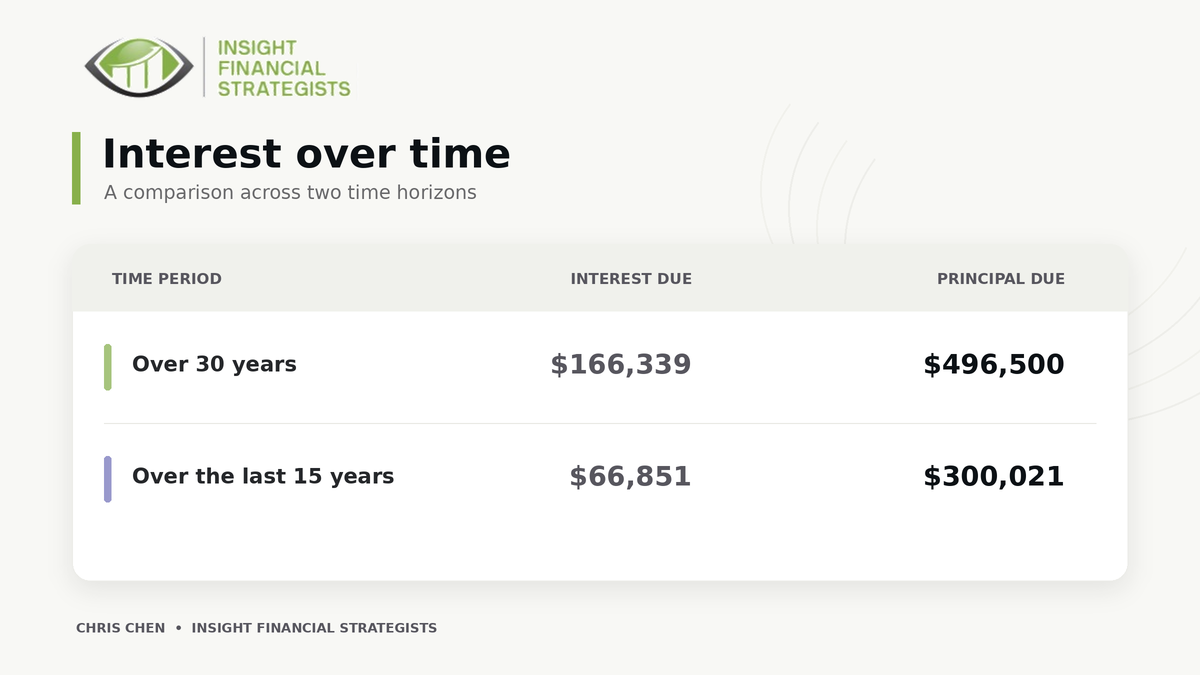
When you look at the decision that way, paying off their mortgage became a question of whether the benefits outweighed all of the costs.
The Recommendation
After working through the numbers, it turned out that the cost of paying off the mortgage, primarily taxes on the incremental retirement account distribution but also potential lost earnings, was meaningfully larger than the $66,851 in interest saved.
My recommendation for Martha’s and Jim’s specific situation was to keep the mortgage. That recommendation was based on their goals, the structure of their assets, their tax situation, and the terms of their mortgage. A different client with different circumstances could receive a very different recommendation.
That wasn't because paying off a mortgage is a bad idea in and of itself. It was because, in Martha’s and Jim’s situation, paying off this mortgage solved one problem while creating several others at a cost they weren’t willing to pay. The financial cost of eliminating the debt outweighed the benefit of eliminating the monthly payment.
One of the things I enjoy most about financial planning is helping clients like Martha and Jim work through decisions like this. Many financial choices sound straightforward until you start asking a few more questions and running the numbers. That's when you begin to see the trade-offs.
Martha and Jim ultimately decided to keep the mortgage because they understood exactly what they would gain, what they would give up, and why. They also knew that the assets were there to pay off the mortgage if it became important. They gained clarity and peace of mind.
If you're approaching retirement and wondering whether to pay off your mortgage, convert to a Roth IRA, claim Social Security, or make another major financial decision, don't rely on rules of thumb. Schedule a meeting with us, and we'll help you work through the numbers, understand the tradeoffs, and determine what makes the most sense for your specific situation.
Frequently Asked Questions
Should I pay off my mortgage before I retire?
There isn't a one-size-fits-all answer. The right decision depends on your mortgage interest rate, where the payoff money will come from, the taxes you may owe, and how paying off the mortgage fits into your overall retirement plan.
Should I use money from my retirement account to pay off my mortgage?
Sometimes, but understand the tax consequences before making that decision. Withdrawals from traditional retirement accounts are generally taxable, and a large withdrawal could increase your tax bill, push you into a higher tax bracket, as well as bump up your Medicare premiums. The amount you need to withdraw may be much more than your mortgage balance.
Is paying off my mortgage always the best financial decision?
No. Paying off your mortgage eliminates a monthly payment, but it can also reduce your retirement savings, create a tax bill, and limit future investment growth. Looking at all of those tradeoffs together can help you make a more informed decision.