
By Chris Chen, CFP®
Last updated: November 2026

Long-term care (LTC) is one of the most important—and most avoided—topics in retirement planning.
In my experience, clients rarely bring it up themselves. Not because it isn’t important, but because it’s uncomfortable. It forces us to think about aging, loss of independence, and uncertainty.
But not planning for LTC can be a very expensive proposition. For those who end up needing it, it will likely be one of your top retirement expenses along with taxes. So, if our goal is to build a retirement plan that helps you not run out of money in your lifetime, then we have to address and plan for your biggest expenses.
That’s why, at Insight Financial Strategists, we make long-term care part of the planning conversation—even when it’s not an easy one.
Table of Contents
Why Long-Term Care Planning Matters
LTC is not a small expense. Today, it can easily exceed $100,000 per year. When you factor in inflation and longevity, the potential future cost becomes significant—often one of the largest financial risks in retirement.
For many, this becomes real when they see a parent or family member go through it. Especially if they help pay for that care. They understand firsthand how disruptive and expensive it can be.
The challenge is not whether LTC matters. The challenge is how to plan for it.
Moving Beyond Rules of Thumb
Historically, most retirement plans relied on broad assumptions.
For LTC, you might assume a certain number of years in care. You might use industry averages. You might build in a generic cost estimate and hope it’s “close enough.”
The problem is that none of us is average when it comes to LTC needs. A generic cost estimate might work, or it might be well off the mark.
When it comes to long-term care needs, being “above average” is not something anyone wants. But if your retirement plan underestimates your LTC need, we may build a plan that looks fine on paper but risks failing where it matters most: it may exhaust your resources before your lifetime is over.
That’s why we’ve moved away from relying on rules of thumb.
How We Use AI to Improve the Planning Process
At Insight Financial Strategists, we use AI-based software to bring more precision to long-term care planning.
Early in the planning process, we ask clients to complete a short questionnaire. From that, the software helps us estimate three key factors:
-
The probability that you may need long-term care
-
The potential duration of that care
-
The estimated cost, in both today’s and future dollars
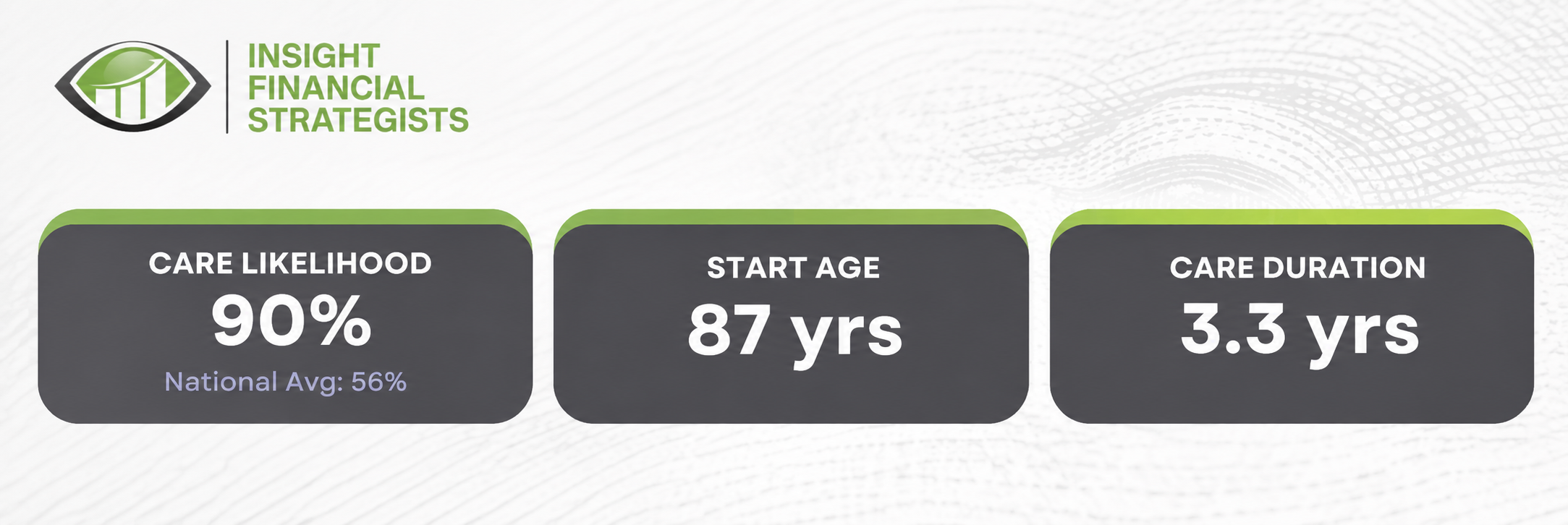
It also breaks long-term care into three phases, from early support at home to more intensive care later on.
This matters because long-term care is not a single event. It’s usually a progression. Some clients strongly prefer aging in place at home, at least initially. Others may eventually require facility-based care.
Instead of using one generic number, our AI software can now model a more realistic path.
The result is not certainty—we can’t predict the future—but it is a much better estimate than what we had before.
Making a Difficult Conversation Easier
Long-term care is still not a pleasant topic. That doesn’t change.
What does change is how we talk about it.
When clients see a probability of needing LTC, whether high or low, it reframes the discussion. It’s no longer abstract. It becomes something we need to plan for, not ignore.
We also walk through what care actually looks like in practical terms—things like needing help with daily activities such as getting out of bed, dressing, or eating.
At that point, the conversation shifts.
It’s no longer theoretical. It becomes real, and more importantly, actionable.
How This Improves Your Financial Plan
This is where the information becomes truly valuable.
Once we have a more realistic estimate of long-term care costs, we can incorporate it directly into your financial plan. That allows us to:
- Stress-test how your plan can withstand this major late-life expense
- Evaluate how much should be self-funded
- Determine whether transferring some of the risk (for example, through insurance) makes sense
- Balance long-term care planning with your retirement lifestyle and legacy goals
Our role is to help you evaluate your options objectively, whether that leads to self-funding or insurance coverage.
In many cases, the answer is somewhere in between, i.e., a combination of strategies.
Why This Matters
Long-term care is one of the biggest variables in retirement planning.
If we underestimate it, the consequences can be severe, potentially depleting assets late in life, when there are few options left to recover.
If we plan for it thoughtfully, however, we can build resilience into your financial plan.
That’s ultimately what this is about.
Not predicting the future perfectly, but preparing for it in a way that allows you to move forward with greater confidence.
The Bottom Line
At Insight Financial Strategists, we believe long-term care planning should not be based on guesswork.
By combining thoughtful planning with better data, we can help you:
- Understand your potential cost
- Make informed decisions about how to address it
- Build a retirement plan that is designed to last
It’s not the easiest conversation, but it’s one of the most important ones we can have.
And it’s one we’re here to guide you through.
Long-term care is ongoing support with daily activities or health needs, often provided at home or in a care facility, typically towards the end of your life. It can become a major retirement expense, so planning for it can help reduce the risk of depleting your savings later in life.
We use a short client questionnaire with AI-based planning software to estimate the likelihood, potential duration, and cost of care. The estimate helps us build a more personalized plan than a general rule of thumb can provide.
There isn’t one answer for everyone. At Insight Financial Strategists, we use AI software to evaluate your probability of needing care and estimate the length and cost. Then, we evaluate whether self-funding, insurance, or a combination of strategies makes sense for your finances, retirement lifestyle, and legacy goals.
Long-term care is potentially one of the largest expenses in your retirement. We incorporate estimated care costs based on your individual information into your financial plan and stress-test how it may hold up. This helps you consider how much to set aside, whether to transfer some of the risk, and how care costs fit with your other goals